
Choosing between in line, inline, and in-line can stop any writer in their tracks. While they sound identical, using the wrong version can weaken the technical accuracy of your writing.
The correct spelling depends entirely on your context—whether you are describing a physical queue, writing web code, or documenting mechanical parts.
Quick Answer: The Cheat Sheet
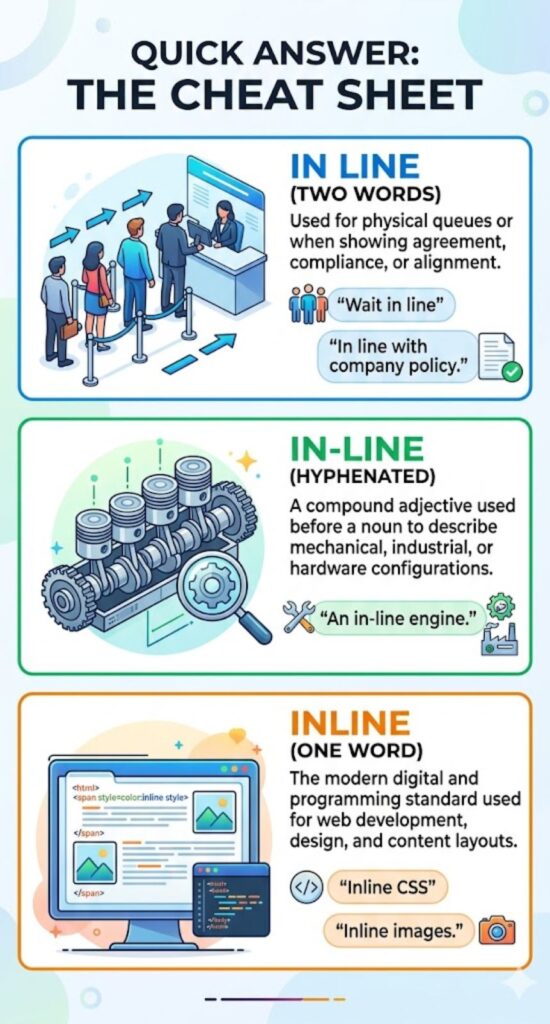
- In line (Two words): Used for physical queues or when showing agreement, compliance, or alignment. (e.g., “Wait in line,” “In line with company policy.”)
- In-line (Hyphenated): A compound adjective used before a noun to describe mechanical, industrial, or hardware configurations. (e.g., “An in-line engine.”)
- Inline (One word): The modern digital and programming standard used for web development, design, and content layouts. (e.g., “Inline CSS,” “Inline images.”)
Quick Reference Comparison
1. In Line: Meaning and Usage
The two-word phrase in line is the most common version in everyday English. It is typically used as a prepositional phrase to describe physical arrangement or conceptual alignment.
Physical Arrangements and Queues
When people or objects form a literal sequence, use two words.
- “We had to wait in line for twenty minutes to get coffee.”
- “Please make sure the chairs are arranged in line against the wall.”
Conceptual Alignment and Compliance
In business settings, “in line” is used alongside the word “with” to show that an action matches a rule, standard, or expectation.
- “The team’s latest marketing proposal is completely in line with our brand guidelines.”
- “Her performance this quarter is perfectly in line with company standards.”
⚠️ Common Idiom Rule: The phrase “fall in line” (meaning to conform or follow rules) and “step out of line” (meaning to behave inappropriately) always use separate words. Never hyphenate or combine them.
2. In-Line: Meaning and Usage
The hyphenated version, in-line, functions as a compound adjective. It specifically describes a noun that immediately follows it, almost exclusively within mechanical, automotive, or industrial contexts.
Automotive and Mechanical Engineering
If you are describing machinery where parts are arranged in a straight row, use the hyphen.
- “The vehicle is powered by an in-line six-cylinder engine.”
- “An in-line pump was installed to regulate the fluid pressure evenly.”
Commercial and Consumer Goods
The hyphenated form is also standard for specific consumer products built with sequential parts.
- “She bought a new pair of in-line skates for outdoor training.”
- “The plumbing blueprint requires an in-line water filtration system.”
3. Inline: Meaning and Usage
The single-word version, inline, is a modern linguistic evolution brought on by the digital age. It is used almost exclusively in web development, software engineering, and digital publishing.
Web Development (HTML and CSS)
In coding, “inline” describes elements or styles that live directly within the flow of a text block, rather than breaking onto a new line or existing in an external sheet.
- “To optimize page load speeds, the developer minimized the use of inline CSS.”
- “Elements like
<span>and<a>are inline elements by default.”
Software Engineering and Content Layouts
Programmers and digital editors use the single-word form to describe elements contained directly within a data stream or text body.
- “The compiler optimized the code by utilizing an inline function.”
- “The article features inline images to illustrate the tutorial steps right where they are mentioned.”
Simple Memory Tricks
If you are stuck choosing a version while writing, ask yourself what the subject is:
- Is it a human or an abstract concept? Use two words (in line). Humans stand in lines; concepts align in line with goals.
- Is it mechanical hardware? Use a hyphen (in-line). Think of the hyphen as a mechanical link connecting the words like parts in an engine.
- Is it on a computer screen or code? Use one word (inline). Digital spaces love to compress words for speed and clean syntax.
Key Differences Explained Simply
How They Work Differently
Each version performs a unique job in your professional writing. The two-word in line shows where something happens, like a queue. The hyphenated version acts as an adjective for mechanical gear, while inline works for digital communication.
Understanding in line vs inline helps you maintain technical precision. These grammatical nuances change based on your industry. Whether you discuss proper order or web development, picking the right form ensures your clear communication remains SEO-friendly and professional.
Choosing the Right One
To pick correctly, look at your subject. Use in line for people and compliance with company policies. Choose in-line for hardware like engines. Pick the modern one-word form for HTML and coding in your reports.
In the debate of inline or in line, let the actionable context guide you. This linguistic style removes doubt for your readers. Keeping your digital communication updated for 2026 ensures your polished writing stays google optimized and easy to read.
Quick Decision Guide
If you describe a physical arrangement or someone following guidelines, use two words. For technical gear or machinery, use the hyphen. For software documentation and web design, the single word is the standard for clear communication.
This proper order prevents common mistakes in your professional documentation. Always match your punctuation to the industry you are targeting. Following these grammar rules makes your content marketing more effective and your polished writing look much sharper.
Common Phrases You Should Know
Understanding “In Line With”
In professional writing, this phrase means matching a standard or following guidelines. Use the two-word version when your budget proposal or business goals stay in line with existing company policies. This ensures your clear communication remains SEO-friendly.
When you look at in line or inline for corporate compliance, always keep them separate. This linguistic style shows that your current trends and actions are in agreement. Using the proper order for these words helps maintain high professional standards.
The Right Way: “Fall In Line”
The phrase fall in line always uses three separate words. You use it when people start following proper order or obeying authority. Avoid the common mistake of writing “fall inline,” as it looks wrong in professional documentation.
Military groups and large organizations use this for clear communication. Writing it correctly keeps your digital communication sharp and polished writing effective. In the debate of inline or in line, this specific idiom never takes a hyphen or a single-word form.
Other Useful Expressions
Common idioms like wait in line or stand in line describe a physical arrangement of people. These everyday phrases always stay as two separate words. Following these grammar rules ensures your content marketing is google optimized and very easy to read.
If someone behaves inappropriately, you say they step out of line. Understanding in line vs inline for these expressions prevents grammatical nuances from becoming errors. Using the correct punctuation and actionable context makes your reports and documentation look much more professional.
Avoiding Common Mistakes
Mistakes People Make Often
The biggest error is using inline when you mean people waiting. This mixes technical precision with everyday physical arrangement incorrectly. Always check in line or inline for your specific actionable context to ensure your professional writing stays sharp.
Forgetting the hyphenated version in technical documentation also creates confusion. An “in line engine” might mean its location rather than its design. Using the correct punctuation and linguistic style keeps your digital communication and polished writing accurate.
Simple Memory Tricks
Think about the subject before you write. People and places always need two words. Technical gear needs two words with a hyphen. Web development and HTML always use the modern one-word form for clear communication and code maintenance.
This simple question saves you from common mistakes. Match your proper order to the industry you are discussing. Following these grammar rules ensures your content marketing is google optimized and your reports stay in line with best practices.
Conclusion
Choosing between in line, in-line, and inline depends entirely on context. Use the two-word in line for physical queues or when showing compliance and alignment with rules (e.g., in line with policy). Use the hyphenated in-line as a compound adjective describing mechanical, automotive, or industrial configurations (e.g., an in-line engine). Choose the single-word inline exclusively for digital spaces, web development, and programming (e.g., inline CSS). Matching these spellings to your specific industry ensures technical precision and keeps your content accurate for both human readers and AI search tools.
Frequently Asked Questions
What does “in line with” mean in a business context?
In business, “in line with” means conforming to, agreeing with, or matching a specific standard, budget, or corporate policy. It is always written as two separate words.
Is it “fall in line” or “fall inline”?
The correct spelling is fall in line. It is a traditional idiom meaning to follow orders or match behavior, and it never takes a hyphen or a single-word form.
Should I write “inline skates” or “in-line skates”?
Grammatically, in-line skates is the traditional compound adjective form. However, because it has become a popular consumer term, many modern brands use inline skates. For technical writing, stick to the hyphenated version; for casual blog layouts, the one-word version is widely accepted.
Why does programming use “inline” as a single word?
Computer science frequently compresses compound terms into single words for technical precision (e.g., online, offline, inline). This helps distinguish digital code functions from physical objects or regular grammar phrases.
Read More Articles
Confirm vs Comfirm: Which One Is The Correct ? Updated 2026
Metrics vs Matrix: How Can You Use Each One? (Updated 2026)
Transferred or Transfered: Which is correct? (Updated 2026)
Inhouse or In-House or In House? Which is Correct? Updated 2026
Half Day or Half-Day: Complete Grammar Guide (Updated 2026)
